By Samar Ameer, Local SEO Specialist
It's the question every owner asks — usually around month two: how long does local SEO take? Maybe you're paying someone and the phone isn't ringing — or doing it yourself and wondering if you've broken something. You deserve a straighter answer than "it depends."
Here it is. Your Google Business Profile runs on a fast clock — movement in roughly 2–8 weeks. Your website runs on a slow clock — 3–6 months for meaningful movement, longer in competitive markets. Google's own guidance is blunter:
"In most cases, the SEO will need four months to a year to help your business first implement improvements and then see the potential benefit." — Maile Ohye, Google (Google's video on hiring an SEO)
Below: your two clocks, a self-assessment, three scenarios, and an audit checklist.
The short answer: you have two clocks, not one
Most "how long does SEO take" articles hand you one blended timeline. A local business has two assets in two different systems, at different speeds.
Clock 1: Your Google Business Profile (the fast clock)
Google controls this listing end to end, so fixes get re-evaluated quickly: a corrected primary category shows an effect within 2–4 weeks, and closing a completeness gap produces movement within 30–60 days. Ranking competitively in the pack still takes a new profile 1–3 months of optimization and reviews — only 11% of professionals in BrightLocal's survey believed a new site could crack it inside two months.
Clock 2: Your website (the slow clock)
Your website earns trust page by page, link by link, compounding slowly. New domains typically see first movement after 2–3 months, lead generation closer to 6–9 months. An Ahrefs study of 2 million pages found only 1.74% of new pages reach the top 10 within a year — local terms are kinder, but that's why your new page hasn't outranked a five-year-old competitor by month two.
| Asset | First movement | Meaningful results |
|---|---|---|
| Profile fixes & category changes | 2–4 weeks | 30–60 days |
| Map pack position | 4–8 weeks after fundamentals are fixed | 60–90 days of steady review + citation work |
| Website rankings | 2–3 months (newer sites slower) | 3–6 months; 6–12 in competitive markets |
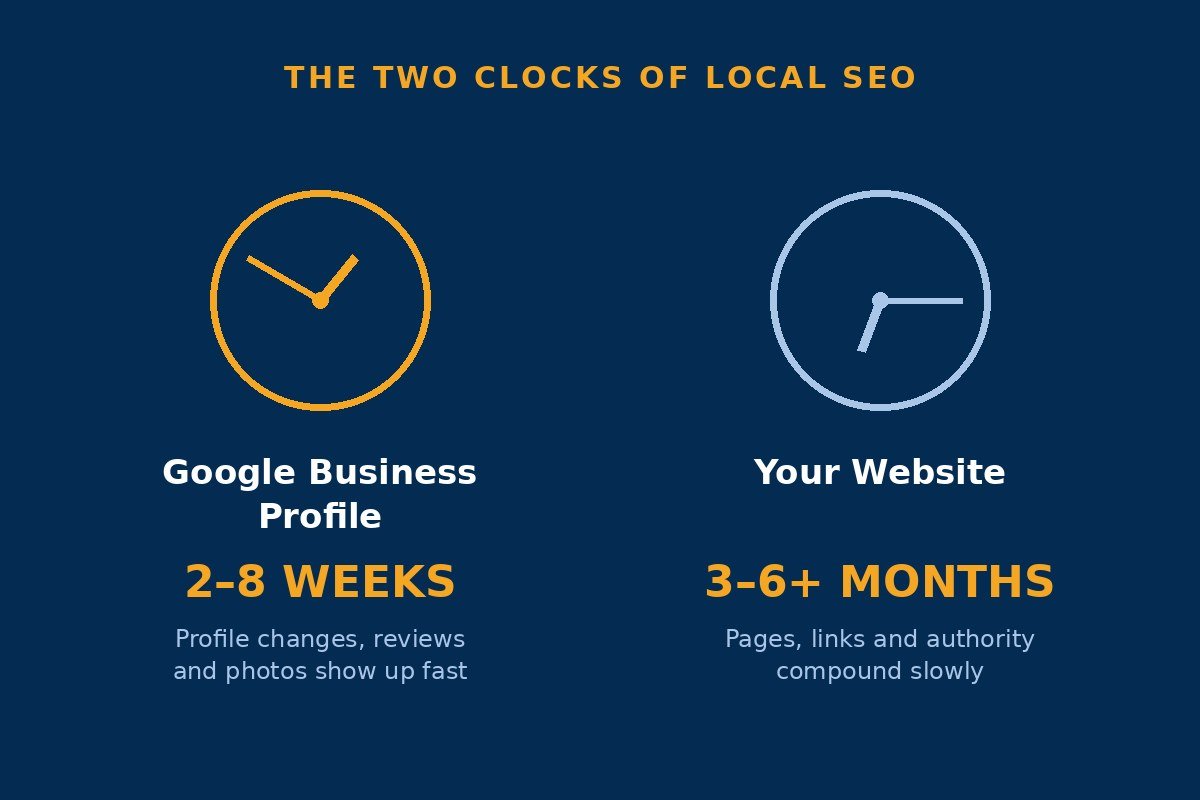
Regular SEO has one clock: your website. Local SEO adds the fast clock — Google ranks local businesses on relevance, distance and prominence, not just page quality — so map movement can arrive in weeks while your website is months from page one. Track only the website and you'll miss all of it.
Find your timeline: the 2-minute self-assessment
Your timeline is set by four things you can score right now, free:
| Check | How to score it | What it does to your timeline |
|---|---|---|
| Review gap | Search your main service + city; average the pack's review counts; compare with yours. | The biggest lever: if they average 80 and you have 12, closing the gap at ~5 reviews a month takes 3–6 months. |
| Profile completeness | Right primary category? Services, hours, 10+ photos, description, attributes, website link, Q&A? | The fastest fix there is for an established business: movement in 30–60 days. |
| Business & domain age | New (under 6 months) or established with history? | New domains: first movement at 2–3 months, leads at 6–9. Established ones start further up the curve. |
| Website state | Indexed? One page per service? Name/address/phone matching your profile exactly? | Indexing problems and mismatched details stall everything downstream — the clock pauses. |
Band A — Fix and climb (established, small review gap, incomplete profile): movement in 2–6 weeks, results in 2–5 months.
Band B — Standard build (established, moderate competition, a real review gap): movement in 1–3 months, results in 3–6 months. Most businesses live here.
Band C — Cold start or cleanup (brand-new, competitive metro trade, or a mess to fix first): movement in 3–5 months, results in 6–12 months.
The month-by-month timeline
What a healthy campaign looks like, clocks split:
| Month | GBP (fast clock) | Website (slow clock) | What you should see |
|---|---|---|---|
| Month 1 | Claimed, verified, completed; review system on; every review answered | Search Console verified, sitemap in, technical fixes done, service pages underway, citation pass | A recorded baseline: rankings, review count, profile numbers. |
| Months 2–3 | Weekly posts/photos; steady new reviews; duplicates merged | Service/location pages published; existing pages optimized; first local links | Impressions climbing; new queries; profile views up 20–30%; positions moving from the 50s toward the 20s |
| Months 4–6 | Map visibility spreading; calls and direction requests trending up | Content and links compounding; service pages contesting page one | Tangible leads — arriving in waves, not a straight line. In BrightLocal's survey, 65% of local SEO professionals said lead generation began at 3–6 months. |
| Months 6–12 | Pack positions defended with steady reviews and responses | Competitive terms still climbing; site becoming a durable asset | Steadier call flow in standard markets; crowded metros and new businesses still building. |
Three scenarios, three different clocks
Scenario 1: Brand-new business
You've done the work, you're verified, and now you're hitting refresh, waiting to see your business on the map. Expect a verification postcard within ~14 days (codes expire after 30), and up to a month — Google's own figure — to appear. Two full weeks of that — still a ghost — means double back over the basics, not panic. Follow Darren Shaw's sequence: citations first, verify, then leave the profile alone for two weeks — heavy early editing can trigger a suspension. Then: 1–3 months to rank competitively in the pack, 6–9 months before the website generates leads reliably. Plan on 6–12 months — the coldest start there is.
Scenario 2: Established business, weak SEO
The fastest honest track: history, reviews, a domain Google knows. Fixes show in 2–4 weeks; early signals at 4–8 weeks, business results at 3–6 months. The case studies people quote come from this scenario: a Whitespark dentist case improved map pack visibility within 45 days via a review push and citation fixes across 20 directories. No magic — basics finally done.
Scenario 3: Recovery — suspension, rebrand, or a citation mess
The track most timeline articles ignore. Suspended? Google says appeal decisions can take up to 5 business days; most resolve in 3–10, complex ones up to ~3 weeks. After reinstatement, allow 24–48 hours to settle; rankings recover in 2–6 weeks if the cause was fixed cleanly. A rebrand or address change restarts a 6–8 week ranking cycle; a domain change typically needs 3–6 months even with proper redirects. Rule of thumb: cleanup adds roughly 1–3 months before your normal clock starts.
Budget cleanup first: reinstatement takes days to a few weeks, rankings recover 2–6 weeks after that, and rebranded details take 2–4 weeks to ripple through citations.
Why it takes longer than you were quoted
When a campaign feels slow, it's usually one of these seven:
- Your review gap — and velocity. Not just the count: whether new reviews keep arriving. Old reviews get discounted; a January burst won't carry you through June.
- Competition density. The same service in a small town and a major metro are different sports — crowded trades take longer.
- Distance. How close the searcher is to you — a factor nobody can optimize away.
- NAP conflicts and duplicates. Listed three ways with two phone numbers, Google hedges instead of ranking you — slow, invisible untangling work (my NAP consistency guide shows the audit).
- A new domain's trust ramp. Often called the "sandbox" (a term Google has never confirmed): new sites are watched before they're trusted.
- Your website's starting state. Unindexed pages, thin service pages, no location pages — every gap delays the start.
- Stop-start effort. Two active months, a pause, two more — momentum resets each time.
What should be done each month: your provider audit checklist
Timelines you can't verify are just stories. The work should exist as URLs, screenshots and logs you can inspect. Audit your provider against it — including if it's you.
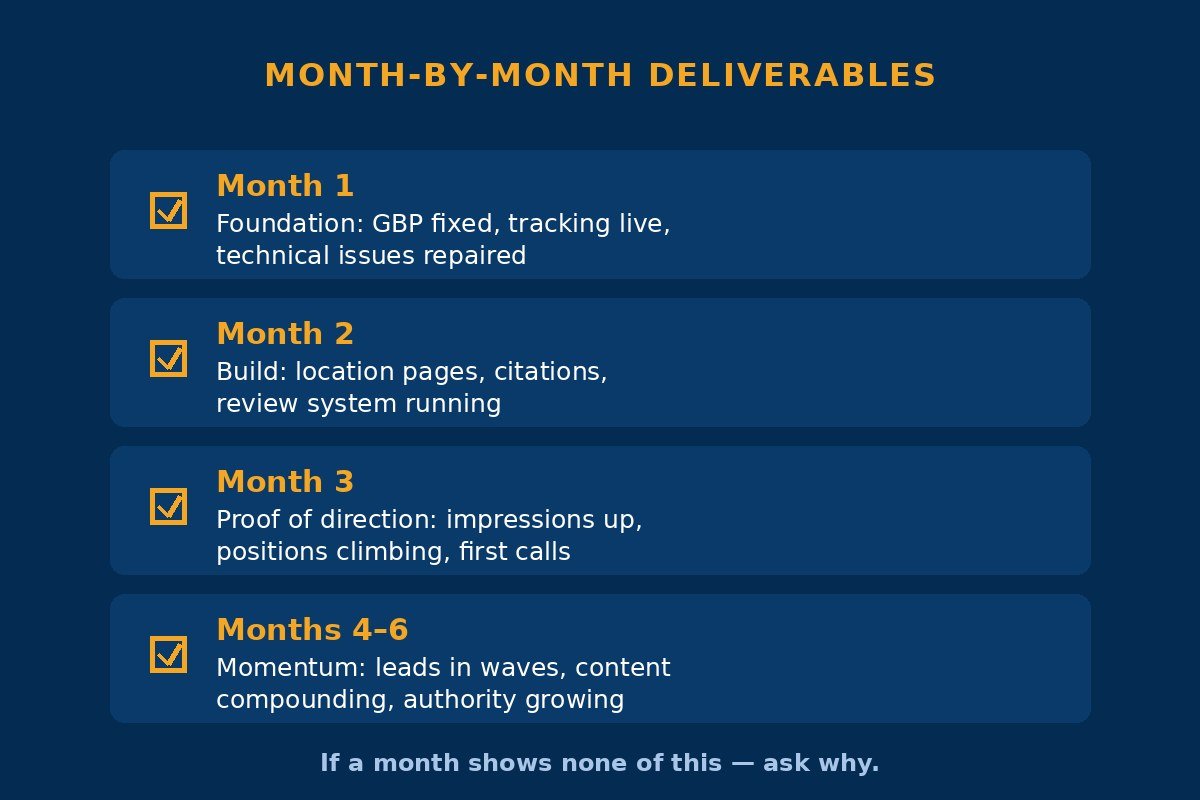
Month 1 — Foundation
- Profile claimed and verified; categories set; services, hours, attributes, description, 10+ real photos
- Baseline recorded (rankings, profile performance, review count); Search Console verified, sitemap submitted, calls/forms tracked as conversions
- Technical pass: key pages indexed, duplicate URLs consolidated, 404s fixed, speed checked
- Core service pages live or in build with LocalBusiness schema; one exact NAP string everywhere
- Review system on: short link created, past customers asked, existing reviews answered
Month 2 — Build
- Service and location pages published — delivered as URLs, not "in progress"
- Citation cleanup: duplicates found, merge/removal requests filed, fixes reported
- Profile cadence: weekly posts, new photos, Q&A managed, reviews answered within ~48 hours
- First local link outreach: chambers, suppliers, press, events contacted
Month 3 — Prove direction
- Optimization log: 4–6 existing pages a month, with what changed on each and why
- One genuinely useful new local page or post — not filler
- The 90-day review against baseline: impressions, query coverage, map visibility, calls
Months 4–6 — Compound
- Steady new reviews monthly, 100% response rate, weekly profile activity
- Citations spot-checked monthly, audited quarterly, a few new quality listings added
- Local link outreach continuing — every earned link reported with its URL
The monthly report is where this gets proven: positions, Search Console trends, new content (title, URL, target keyword), backlinks with the linking page's URL, pages optimized with changes, profile performance, technical issues found and resolved, and next month's plan. As one agency's published standard puts it: "If your agency's monthly report does not include the exact URLs of new content and the exact URLs of backlinks earned, you cannot verify what was delivered. A report without evidence is not a report — it is a summary of claims."
Signs it's working before rankings move
Owners rarely ask about rankings — they ask "how long until I see a difference?" Here's the chain to watch, each link with an exact place to look:
Crawl & indexing → impressions → query coverage → rankings → map visibility → actions → calls
- Profile views and actions: GBP dashboard → Performance tab. Rising views (20–30% across months 1–2) mean Google is showing you more, and calls and direction requests trend up first.
- Impressions: Search Console → Performance: climbing impressions are an early sign changes are gaining traction.
- New queries: Search Console → Performance → Queries tab. New queries surfacing in months 3–4 mean coverage is widening.
- Positions on secondary terms: average position improving from the 50s toward the 20s on long-tail terms comes before top-10s on money keywords.
- Reviews: your profile's Reviews section — steady growth and a 100% response rate (the system in my review response guide).
- Indexing health: Search Console → Pages report. New service pages belong in the index, not in "discovered" limbo.
If the chain's early links move by month 3, the later ones usually follow — and the chain shows you where a stalled campaign is stuck. That's the conversation to have with your provider, evidence open on both screens. Search Engine Land's guide uses the same logic.
The finish line has a sound: customers who looked for months writing "I wish I had found them sooner" — or, about a wait like yours, "well worth the 6-8 week wait." Nobody can schedule that week; the chain above is how it's earned.
Red flags: your provider is stalling you
Some slowness is normal. These are not — they're tells:
- A ranking guarantee. Google says there's no way to request or pay for a better local ranking — a guarantee is fine print on a keyword nobody searches, or manipulation ending in penalty or suspension.
- Page one in 30 or 90 days. Especially the map pack — providers promising this bet you'll quit around month five, just before a real campaign's curve bends.
- Reports that count activity, not outcomes — with no URLs. "200 keywords tracked, 40 directory submissions" is effort, not results — and if a report never names the exact pages created or links earned, nothing in it can be verified.
- They own your accounts. Your profile, Search Console and analytics belong in your accounts, provider as manager — never held as owner in theirs, which only protects them against you leaving.
- Fixed monthly link quotas, "secret methods," 12-month lock-ins. Links worth having can't be manufactured to a quota; unexplained "proprietary" methods can't be audited; honest providers keep you with evidence, not lock-in contracts.
What the timeline means for your budget
A timeline is a budget in disguise: months of work × a monthly cost. The honest question isn't "how fast?" but "what do those months buy — is the maths worth it?" I've broken down what local SEO costs month by month, and whether local SEO is worth it — read both before signing anything. DIY is legitimate but slower — one comparison: 9–12 months to pack visibility versus 4–6 managed. Several locations? Each branch runs its own clock — see the multi-location playbook.
When it's genuinely not working
Patience has limits. Three checkpoints:
- By month 2: no deliverables log — no URLs, no screenshots, no "here's what we changed" — is a work problem, full stop.
- By month 3: no leading indicators moving and no work log explaining why. One can lag; both together can't.
- By month 6: nothing measurable has changed from baseline. The conversation is no longer "give it more time" — it's "show me the evidence, or I walk."
Owners land here often — one forum complaint describes £1,000 a month for six months with "no thrilling results" and nothing to inspect. The checklist above exists so that never has to be you.
Frequently asked questions
How long does local SEO take to work?
Established business? Plan on 3–6 months: profile movement in weeks, website rankings in months. New or competitive-market businesses: 6–12 months. These are planning ranges from industry surveys and Google's guidance — not promises.
How long before a new GBP starts ranking?
A new profile can appear within days of verification, but ranking competitively in the map pack usually takes 1–3 months. Google says new businesses can take up to a month to appear at all.
How long does it take to rank in the map pack?
With a full profile, expect first movement in 4–8 weeks and call-generating positions after 60–90 days of review and citation work. Only 11% of professionals in BrightLocal's survey believed a new site could crack the map pack inside two months.
Why is my SEO not working after three months?
Check the work: were the month 1–3 deliverables done — profile completed, pages published, citations cleaned, reviews flowing? Deliverables done and impressions climbing = the normal curve. No work log and nothing moving = the campaign is the problem.
Why is a competitor with fewer reviews outranking me on Maps?
Review count is only part of prominence — not a leaderboard. Google also weighs relevance (categories, services) and distance: a nearer competitor with the right primary category can outrank you with fewer reviews. Check theirs first.
How many Google reviews do I need to rank in the map pack?
No magic number — what matters is your gap to the pack. If they average 80 reviews and you have 12, closing it is a 3–6 month project. Recent reviews weigh more, so velocity beats a one-time burst.
Can I speed up local SEO results?
You can remove what slows it down: fix a category error, complete the profile, clean citations, switch on a review-request system, publish your service pages. Trust itself can't be compressed — shortcuts around it usually end in a suspension.
How can I tell if my SEO is working?
Watch the chain: pages indexed, impressions rising in Search Console, new queries, positions moving from the 50s toward the 20s in Search Console — then map visibility, calls and direction requests in your GBP Performance tab. Early movement by month 3 means the rest follow.
The bottom line
Local SEO takes weeks where Google controls the asset (your profile) and months where trust must be earned (your website). Plan on 3–6 months if established, 6–12 if new, competitive or cleaning up a mess — and judge by deliverables and leading indicators, not by whether the phone rang this week. Owners who get burned aren't the ones who waited; they're the ones who waited without evidence.
If you'd rather not run the checklist yourself, my local SEO services are built around exactly this: recorded baselines, inspectable deliverables, reports with URLs instead of adjectives. No ranking promises — just the work, shown.
I'm Samar Ameer, a local SEO specialist. I help local businesses and multi-location brands turn Google searches into calls — with profiles, pages, and review systems that get maintained.
Keep reading
What the months in this timeline actually cost — and what they buy.NAP Consistency: The Invisible Ranking Killer
Conflicting business details quietly pause your timeline — audit yours in an hour.Is Local SEO Worth It?
The honest maths for deciding whether the wait pays off.