By Samar Ameer, Local SEO Specialist
Three letters. Three pieces of information. And more quiet ranking damage than almost anything else a local business can get wrong.
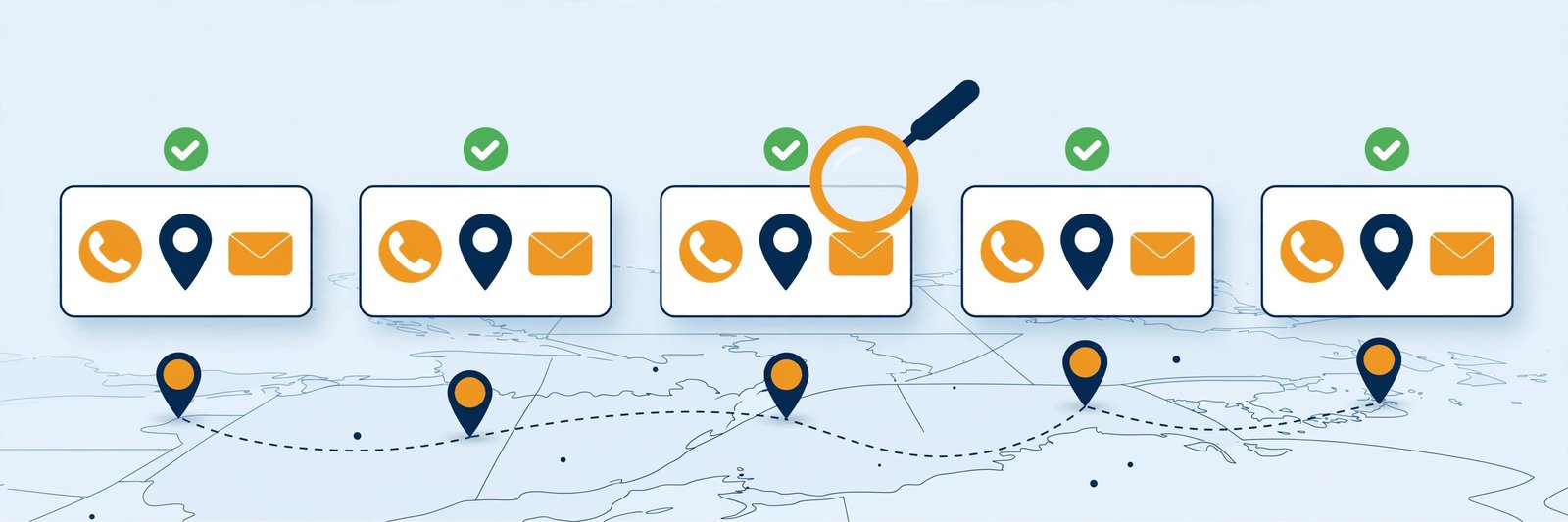
NAP consistency means your business Name, Address, and Phone number appear identically across your website, Google Business Profile, and every directory or citation online. Google cross-references these mentions to confirm you are one real business; mismatches lower its confidence in your data and quietly cost you map pack rankings.
I see NAP problems in almost every local SEO audit I run. Not because business owners are careless — because the inconsistencies accumulate invisibly. An old phone number on Yelp. A previous address still living on three directories nobody claimed. "St" on the website, "Street" on Facebook, a tracking number on Angi. Each one is tiny. Together, they tell Google your business information cannot be fully trusted.
This guide explains NAP plainly, shows you exactly where it must match, walks you through a self-audit, and covers the mismatch patterns I find most often — including a finding from my own audit of 13 Arizona garage door businesses, where more than half had NAP problems.
What NAP means — and why Google cares
NAP stands for Name, Address, Phone number. It is the identity trio that follows your business across the web: your website, Google Business Profile, Yelp, Facebook, industry directories, data aggregators, even passing mentions in local news articles.
Google treats NAP as a trust signal, not a ranking trick. Google cannot visit your shop, so it cross-references: every place your NAP appears identically is a vote that your business is real and where you say it is. Every disagreement is a contradiction that lowers confidence.
That is why NAP inconsistency hurts even when everything else is perfect. You can have a beautiful website, 200 reviews, and great photos — but if Google sees three different phone numbers for the same business, its confidence drops. In local search, confidence is currency.
WHAT GOOGLE SAYS
Honest scope note first: Google publishes no page titled "NAP consistency." Its official stance, from the local-ranking and business-guidelines docs, is that consistent, accurate business information is what lets Google match a business to local searches — and inconsistent or embellished naming risks suspension. In other words, Google never names "citations" as a standalone factor; it demands the underlying accuracy citations are built from.
Source: Google Business Profile Help
Do local citations still matter in 2026?
Let me give you the honest answer most citation guides avoid: citations are table stakes, not a growth lever.
Ten years ago, building hundreds of citations moved local rankings. Today, the map pack is won by your Google Business Profile quality, reviews (count, velocity, and how you respond), and proximity. A mountain of directory listings will not outrank a competitor with 150 recent reviews and a complete profile.
But "table stakes" still means required: citations do not win the game, but broken ones can lose it. Get them clean and consistent, then focus your energy where rankings are actually won.
And there is a new reason to care in 2026: AI search. ChatGPT, Google's AI Mode, and voice assistants cross-check business facts before recommending a company — conflicting phone numbers or addresses often mean the model omits you and recommends a competitor with cleaner data instead.
WHAT THE EXPERIMENTS SHOW
BrightLocal's study of 122,125 businesses: the local top 10 average 81 citations; #1 averages 86 vs #10 at 75. And citations came back "through the AI door" — in Whitespark's 2026 AI-visibility scoring, 3 of the top 5 factors are citation-shaped. Ahrefs' 75,000-brand study found branded web mentions correlate with AI Overview visibility at 0.664 vs just 0.218 for backlinks. Semrush's "ghost citations" study adds a twist: 62% of AI citations never mention the brand in the answer text at all.
Source: BrightLocal / Ahrefs / Semrush
Where your NAP must match: the full list
Start with these. Everything else is secondary.
- Google Business Profile — the anchor. This is the master record everything else gets compared against.
- Your website — especially the footer (every page) and the contact page. Back it up with LocalBusiness schema markup carrying the identical NAP.
- Apple Maps and Bing Places — the two biggest map ecosystems after Google.
- Facebook and Instagram — check the business page About section, not just the posts.
- Yelp, Angi, BBB, HomeAdvisor, Thumbtack — the tier-one review and lead directories for US service businesses.
- Industry-specific directories — Avvo for lawyers, Healthgrades for doctors, Houzz for remodelers, and whatever the niche directories are in your trade.
- Local directories — Chamber of Commerce, local tourism boards, neighborhood sites.
- Data aggregators — Foursquare, Data Axle, and Neustar/Localeze feed hundreds of smaller directories, so errors here multiply.
One thing people forget: listings you never created. Directory scrapers clone old datasets and dormant profiles linger for years — many NAP problems I find are on pages the owner did not know existed.
What I found: 7 out of 13 businesses had NAP problems
In my audit of 13 garage door repair businesses in Buckeye, Arizona, NAP inconsistency was the single biggest pattern: 7 of the 13 had their name, address, or phone number mismatched across Google, Yelp, Facebook, and industry directories.
The typical mess: a different phone number on Yelp than on Google, an old address still live on two directories from before the business moved, an abbreviated name on one site and the full legal name on another.
Several were losing map pack positions to competitors with weaker reviews and thinner websites — simply because Google could not fully trust their information. NAP cleanup was my first recommendation for every one of them: the cheapest fix with the clearest payoff.
How to audit your NAP: the step-by-step method
Here is the exact process I follow:
- Write your source of truth first. Write down your one canonical NAP: the exact business name (as on your signage, no keyword stuffing), the exact address, and your one primary phone number. Every fix points back to this document.
- Check your anchor properties. Open your Google Business Profile, your website footer and contact page, Facebook, Apple Maps, and Bing Places. Copy the exact NAP from each into a spreadsheet. Flag anything that does not match — and claim any listing you do not control yet.
- Search for listings you did not know about. Run exact-match searches: your current phone number in quotes, every retired phone number, your old address in quotes, and your name with and without legal suffixes. Add site-specific searches like
site:yelp.com "Your Business Name". Log every result — correct ones are your baseline, wrong ones your fix list. - Check your LocalBusiness schema. Use Google's Rich Results Test to confirm your schema carries the same NAP as the visible page text. A mismatch between what humans see and what machines read is a classic hidden error.
- Fix in priority order. Google Business Profile first (the anchor), then your website (the source), then Facebook, Apple Maps, and Bing Places, then Yelp and tier-one directories, then aggregators (so corrected data flows downstream), and finally everything else.
- Merge duplicates and claim stragglers. If you find duplicate listings, identify the one with the correct information, claim it, and request the duplicates be merged or removed. Duplicate profiles split your citation strength and confuse customers.
- Re-check at four and twelve weeks. Re-run the searches from step 3 to confirm fixes stuck — and to catch any aggregator that re-sent the old data.
A spreadsheet with columns for platform, URL, name, address, phone, and status (correct / wrong / duplicate / unclaimed) is all the tooling most single-location businesses need.
NEIL PATEL'S TAKE
Neil Patel's nuanced take: NAP citations are "not as important as they used to be for local SEO, but they are still valuable" — they signal the business is active and trustworthy. His most actionable tactic: if a map-pack competitor is listed on a directory you're missing, treat that as a signal and prioritize niche-relevant directories over sheer quantity. Technical note worth keeping: NAP must be crawlable HTML text, never baked into an image.
Source: neilpatel.com
The 7 most common NAP mismatch patterns
| The mismatch | Why it happens | How to fix it |
|---|---|---|
| Abbreviations vs full words — "St" vs "Street," "Ave" vs "Avenue," "Ste" vs "Suite" | Different team members or agencies entered data differently over the years | Pick one format and apply it everywhere |
| Suite/unit inconsistencies — "Suite 4" on one site, "Unit 4" on another, missing entirely on a third | Some directory forms do not have a suite field, so people improvise | Use the same suite format everywhere you can control it |
| Tracking phone numbers — different numbers on every directory to measure which one drives calls | Marketing agencies set up per-channel tracking numbers years ago | See the tracking-number section below |
| Old addresses after a move — previous location still live on directories and aggregators | No cleanup after the move; aggregators re-send old data | Update GBP first, then aggregators and top directories; monitor for 60–90 days |
| Name variations — legal suffixes ("LLC"), keyword stuffing ("Best Plumber Dallas"), franchise naming differences | Owners or agencies thought adding keywords to the name would help rankings | Use the real-world business name exactly — keyword-stuffed names can trigger GBP moderation |
| Service-area businesses showing address inconsistently | Mobile businesses changed address-display settings at different times | Set one rule (service areas only, no displayed address — or consistent displayed address) and mirror it everywhere |
| Phone format differences — (555) 123-4567 vs 555-123-4567 vs +1 555 123 4567 | No one standardized the format | Trivial formatting alone rarely hurts, but pick one format anyway — uniformity costs nothing |
The call-tracking number trap
This deserves its own section, because it is the single most common serious NAP problem I find in client audits — and it is usually there because an agency did it on purpose.
The setup goes like this: an agency puts a different tracking number on every directory so the client can see which one drives calls. To Google, five numbers can look like five different businesses — and your trust signal fractures.
You do not have to choose between attribution and consistency. The two safe options:
- Dynamic number insertion on your website only. Visitors from different channels see a tracking number, but crawlers and the cached source code always show your canonical NAP number. The directories keep the real number; only on-site sessions are tracked.
- Port the tracking number to your carrier. Make the tracking number your actual, permanent primary business number. Then it is your NAP everywhere — no mismatch at all.
Do not rely on stuffing your real number into the GBP's "additional number" field while a tracking number sits as primary. That trick softens one contradiction — it is not a substitute for one published number everywhere.
NAP in the AI search era
When someone asks ChatGPT or Google's AI Mode for "the best plumber in Plano," the model does not query the Google Business Profile the way Maps does. It reasons across sources — directories, reviews, your website — and cross-checks facts. Conflicting phone numbers or addresses make your business ambiguous, and LLMs handle ambiguity by omitting you rather than risking wrong information.
So NAP consistency is now a GEO issue too: the same clean entity data that feeds Google's local algorithm also feeds AI answers and AI Overviews. Consistent NAP plus clean LocalBusiness schema is the cheapest GEO foundation you can build.
WORLDWIDE DATA
62% of consumers will avoid your business if they find incorrect information about it online (BrightLocal). That's the entire business case for NAP consistency in one sentence.
Source: BrightLocal via Street Fight
Frequently asked questions
What does NAP stand for in local SEO?
NAP stands for Name, Address, and Phone number — the three pieces of business information that identify you across the web. Google cross-references your NAP everywhere it appears to confirm you are one real business. When listings disagree, Google's confidence in your data drops, and your local rankings suffer.
Do local citations still matter for local SEO in 2026?
Yes, but their role has changed. Citations are now table stakes rather than a growth lever: consistent NAP across directories is a foundational trust signal, not a ranking hack. Reviews, a strong Google Business Profile, and proximity matter far more for winning the map pack. Fix citations once, audit quarterly, and focus your energy on what actually moves rankings.
How often should I audit my NAP consistency?
Run a full NAP audit at least twice a year, plus a quarterly spot-check of your core listings (Google Business Profile, website, Facebook, Yelp). Audit immediately after a move, a phone number change, a rebrand, or finding a duplicate listing — old details can linger on aggregators for months if you do not chase them.
What should I do if my business moved to a new address?
Update your Google Business Profile first, then your website's footer, contact page, and LocalBusiness schema. Next, update the major directories (Yelp, Facebook, Apple Maps, Bing Places) and the data aggregators that feed hundreds of smaller directories. Plan on 60–90 days for changes to propagate everywhere, and keep monitoring for the old address resurfacing.
Do I need the exact same phone number on every listing?
Yes — one primary number should be the public NAP everywhere. For call tracking, use dynamic number insertion on your website so crawlers still see your canonical number, or port the tracking number with your carrier so it becomes your permanent primary number. A different static number on every directory is a classic NAP killer.
Does "St" vs "Street" really matter for NAP consistency?
Minor abbreviations like St vs Street rarely cause damage on their own — Google's systems resolve common abbreviations. What hurts is inconsistency at scale: a wrong phone number, an outdated address, a materially different business name, or dozens of small variations across the web. Still, pick one format and use it everywhere, because uniformity leaves Google nothing to resolve.
Get your free local SEO audit
Want me to check your NAP consistency across the major directories — plus your Google Business Profile, reviews, and what the top-ranked businesses in your market are doing differently? I'll personally audit your business and show you exactly what's holding your map rankings back.
Get your free auditI'm Samar Ameer, a local SEO expert. I found NAP inconsistencies in 7 of the 13 businesses in my Buckeye, AZ audit — this guide is the exact process I use to find and fix them.
Keep reading
The page anatomy behind local rankings — headings, FAQs, and local signals that move the needle.What Is AEO? How to Write Content That Wins AI Overviews
AEO is how content gets picked for Google AI Overviews. Here's how to structure articles that AI quotes.GEO Explained: How to Get Cited by ChatGPT
Generative engine optimization: what makes AI quote your content instead of someone else's.Voice Search Optimization for Local Business
Voice search optimization for local business: capture conversational, question-based searches with content that speaks your customer's language.