By Samar Ameer, Local SEO Specialist
Here's the hard truth about franchise marketing: Google doesn't rank brands. It ranks locations. When someone searches "near me," your national brand name carries almost no weight — the battle is won or lost by each individual location's profile, page, and reviews, in its own city, against the local competitor down the street.
That's why so many franchises look strong nationally and invisible locally. This guide is the complete system for fixing that: one website structure that scales, a Google Business Profile checklist for every location, location pages that aren't copy-paste duplicates, and a clear split of who does what — headquarters or the local owner.
Why local SEO for franchises is a different game
Single-location SEO is a duel. Franchise SEO is running that same duel in 10, 50, or 500 towns at once — while keeping every location's name, branding, and information consistent. Three things make it harder:
- Every location has different competitors. Your Austin branch isn't competing with your Dallas branch; it's competing with the beloved local business that's been there 20 years.
- Consistency breaks at scale. One location changes its phone number, another uses an old logo and a shortened name, a third never claimed its profile — and Google's confidence in all of them drops.
- Duplicate content is the default. The easiest way to build 50 location pages is to copy one page 50 times. It's also the fastest way to make sure none of them rank.
The fix is a system: central standards from the franchisor, local proof from each location. Everything below is that system, step by step.
One website or many? The structure that wins
The most common franchise question — and the most expensive to get wrong. The pattern across franchises that rank well is consistent: one strong domain, with a dedicated page per location in subdirectories.
- One domain (yourbrand.com) pools authority instead of splitting link value across dozens of weak sites.
- A locations hub: yourbrand.com/locations/ listing every branch, ideally grouped by state or region.
- One page per location: yourbrand.com/locations/austin/ — a real page, not a database printout.
Separate websites per franchisee create duplicate content, thin authority, and brand chaos — three headaches you'll pay for every month. One domain with great location pages is the long-term play.
Yes — one profile per genuine, eligible location. Each branch needs its own staff presence, accurate address (or defined service area), and customer access during its listed hours. Virtual offices and duplicate listings for the same location don't qualify and risk suspension.
Location pages that rank (and the template to build them)
A location page has one job: prove to Google — and to a customer standing three miles away — that this specific branch is real, local, and the right choice. Copy-pasting the same 200 words and swapping the city name fails that job. Every location page needs these blocks:
- Unique headline: [Service] in [City] — not the brand slogan repeated 50 times.
- Local intro (150+ unique words): the neighborhoods served, local landmarks, how long this branch has served the area.
- Full NAP block: exact name, address, and local phone number — matching the GBP character for character.
- Services at this location: the actual services offered here, linked to your service pages.
- Local proof: photos of this branch and team, reviews from this branch's customers, local offers.
- Practical details: hours, parking, directions, an embedded map.
- LocalBusiness schema: this location's own name, address, geo coordinates, hours, and phone in JSON-LD.
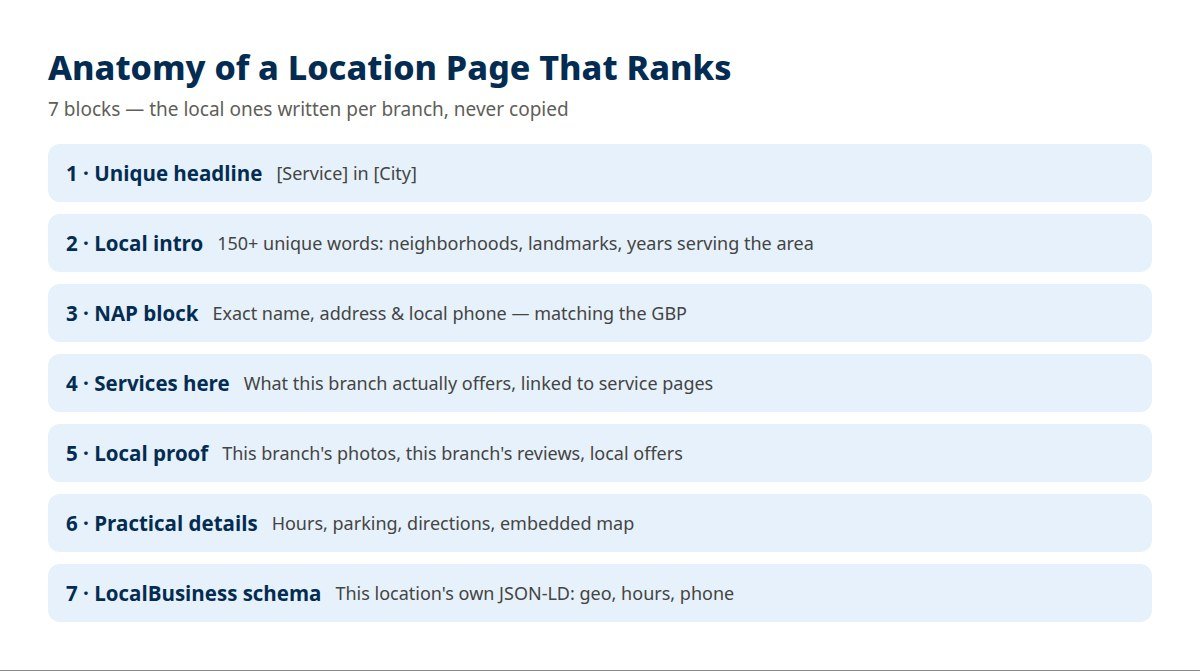
Give franchisees a fill-in version of this template plus two or three locally written paragraphs, and you get consistency without duplication.
One Google Business Profile per location: the checklist
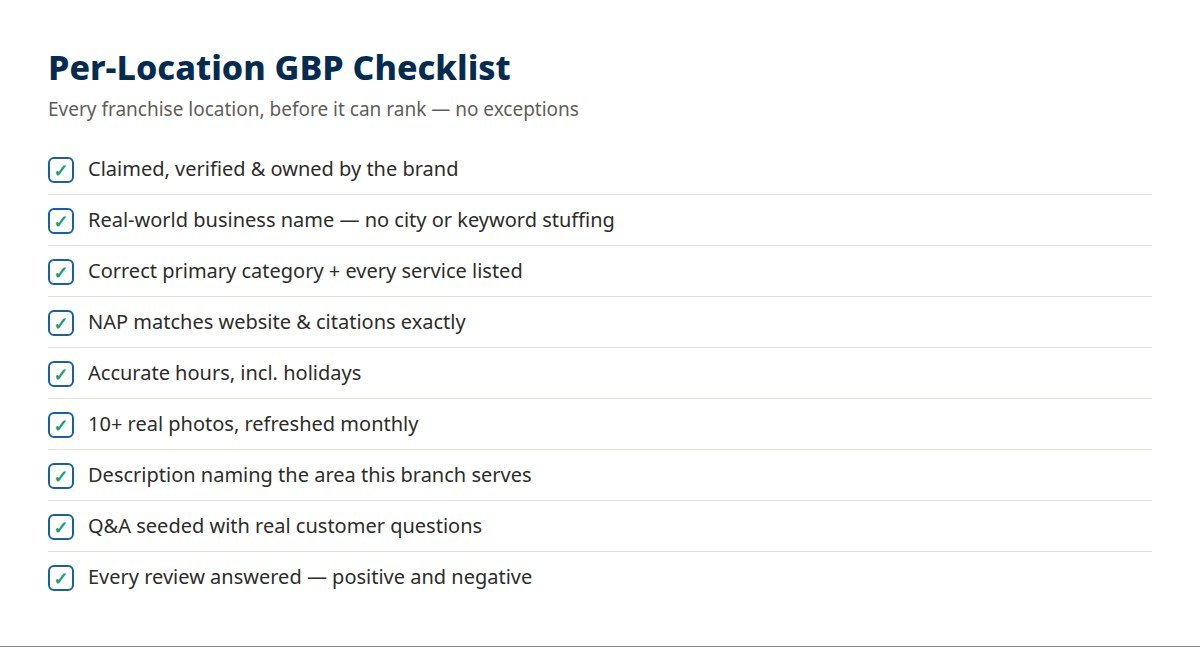
Your GBP is your most powerful local asset — it's what appears in the map pack, where the calls happen. Every location, no exceptions, gets the full treatment:
- ☐ Claimed, verified, and owned by the brand (never solely by an ex-franchisee)
- ☐ Business name = the real-world name only — no city or keyword stuffing
- ☐ Primary category correct; every service listed individually
- ☐ Address and local phone matching the website and citations exactly
- ☐ Accurate hours, including holiday and special hours
- ☐ 10+ real photos at launch (storefront, interior, team, work) — refreshed monthly
- ☐ Business description naming the area served and what this branch is known for
- ☐ Q&A seeded with the questions this location actually gets
- ☐ Review routine running (see below) — every review answered
Service-area locations (common for home-service franchises) can hide the address and define a service area instead. The location still needs a real base of operations — Google may ask for verification proof — but customers see your coverage area, not a home address.
NAP consistency and citations at scale
For one location, citation cleanup is an afternoon. For fifty, it's an operation. Name, Address, and Phone (NAP) must match exactly — same abbreviations, same suite format, same phone — across Google, Yelp, Facebook, Apple Maps, industry directories, and local chambers, for every single branch.
The workflow that works at scale:
- One master record per location — a single spreadsheet row that is the source of truth for that branch's NAP.
- Build the core citations first (the major platforms above), then industry and city directories.
- Audit quarterly. Locations move, franchisees change numbers, aggregators re-publish old data. Search each location's name + phone and fix mismatches — this recurring cleanup is where multi-location rankings are quietly won and lost.
- Close the loops on exits. When a franchisee leaves or a location closes, update or close every listing — stale profiles for dead locations confuse customers and Google alike.
This is unglamorous work, and it's exactly why my guide to NAP consistency matters even more for franchises than for single locations: multiply every small mismatch by your location count.
Reviews: every location builds its own reputation
A 4.9-star flagship in one city does nothing for the 3.8-star branch three states away — customers choose the branch near them, based on that branch's reviews. So review generation runs per location:
- Each location asks its own customers, right after the job or visit, with its own review link.
- Every review gets a reply from that location — I cover the exact responses, including for negative and fake reviews, in my guide on how to respond to a Google review.
- Headquarters monitors rating and response rate per location monthly; a slipping branch gets help before it becomes the brand's problem.
How Google actually ranks your locations
Google states that local rankings rest on three factors, and each one plays out per location:
- Relevance — how completely your profile and pages describe what the searcher wants. Complete categories, full service lists, and detailed location pages are relevance.
- Distance — how far the searcher is from the location. You can't move your branch, but accurate addresses and service areas make sure you're counted in the right searches.
- Prominence — how well-known and trusted the location is: reviews, ratings, links, citations, and local mentions.
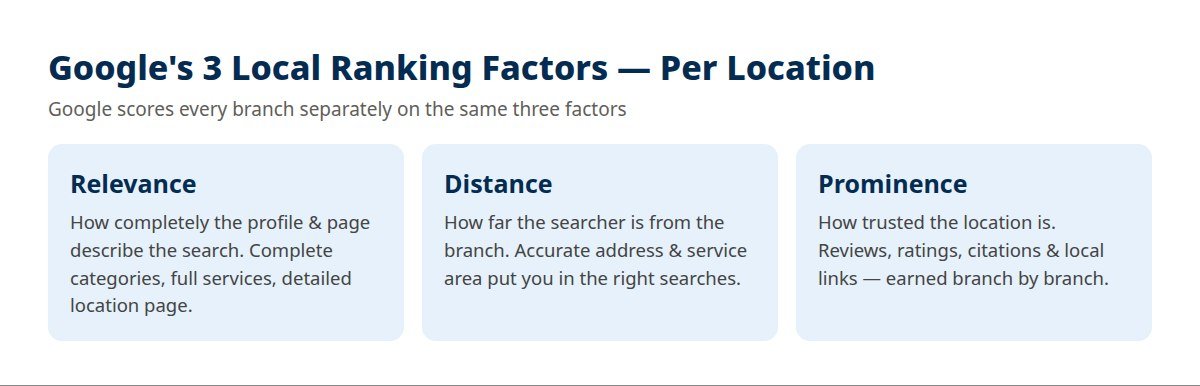
"Near me" rankings are just the three factors above, measured at the moment of search: a complete GBP (relevance), an accurate location (distance), and reviews plus citations (prominence). There is no separate "near me" trick — a location that's strong on all three shows up; one that isn't, doesn't.
Franchisor vs franchisee: who does what
The franchises that fail at local SEO usually fail here — not on tactics, but on ownership. The split that works:
Headquarters owns: the website and location-page template, the master NAP records, citation building and cleanup, the GBP checklist and audits, brand assets and photo standards, and monthly reporting per location. Listing-management and review tools with multi-location dashboards make this manageable instead of manual — checking and updating dozens of profiles one by one is where errors creep in.
Each location owns: real local photos, answering its own reviews, seeding its Q&A, local offers and events, and community presence — sponsorships, local partnerships, and the local links that no central team can earn from head office.
Then run a quarterly local marketing audit per location: profile completeness, NAP check, review health, page updates, photo freshness. Thirty minutes per location, four times a year, catches nearly every problem described in this guide while it's still cheap to fix.
Local links: the prominence each branch earns itself
National press mentions build the brand, but a location's map rankings respond to local proof: links and mentions from its own city's websites. This is the one ranking asset headquarters cannot manufacture centrally — and the one most franchises never build. Per location, the realistic sources are:
- The local chamber of commerce and business associations (a citation and a link in one).
- Sponsorships — youth teams, school events, charity runs — which earn local news and community-page links.
- Local suppliers, partners, and neighbouring businesses with "partners" or "find us at" pages.
- City event listings and local bloggers covering openings, offers, and community work.
Ten genuinely local links will do more for a branch than a hundred generic directory submissions. Give every franchisee a one-page playbook of the four sources above and a small monthly target — one new local link or mention — and prominence compounds quietly in every market at once.
What to measure for each location
You can't manage 50 locations on brand-level reports. Each branch gets its own small scorecard, reviewed monthly:
- GBP actions: calls, direction requests, and website clicks from that location's profile (in Business Profile performance).
- Map visibility: is the branch in the top 3 for "[service] in [city]" and "[service] near me" from its own area?
- Review health: average rating, new reviews this month, and response rate.
- Page performance: organic visits and calls from that branch's location page.
Rank the locations against each other. The bottom three each quarter get the next round of help — that's how a franchise system improves steadily instead of only fixing whichever branch complains loudest.
5 franchise local SEO mistakes that quietly kill rankings
- Copy-paste location pages. Fifty identical pages with swapped city names get filtered as duplicates — write the local blocks per branch.
- One profile, many locations. A single GBP trying to represent several branches means most branches simply don't exist in local search.
- City names stuffed into business names. "Brand Name – Best Plumber Austin TX" violates Google's naming rules and risks suspension; the real-world name only.
- Letting franchisees freelance their listings. Unvetted changes to names, categories, and phone numbers are the number one source of NAP chaos.
- National content only. A blog full of brand news and zero local content gives each location page nothing to stand on.
Frequently asked questions
What is local SEO for franchises?
It's local SEO run as a system across many locations: one website with a unique page per branch, one complete Google Business Profile per location, consistent citations everywhere, and reviews managed per location — coordinated centrally so the brand stays consistent while each branch competes in its own market.
Should each franchise location have its own website?
Almost never. One domain with location pages in subdirectories (yourbrand.com/locations/city/) pools your authority, keeps branding consistent, and avoids duplicate content. Separate sites split your link value and multiply maintenance.
How many Google Business Profiles can one company have?
One per genuine location. Each branch that serves customers at its own address (or as a service-area business) with its own staff qualifies for its own profile. Duplicates of the same location and virtual offices do not.
How long does local SEO take for multiple locations?
Profile and citation fixes can move individual locations within weeks; competitive map-pack gains typically build over 3–6 months per market. Locations in quieter markets move faster than flagship-city branches facing entrenched local competitors. Anyone promising simultaneous page-one rankings for every branch is selling, not informing.
How do service-area franchise locations rank without an address?
They use a service-area profile with the address hidden, rank within their defined area, and lean harder on the factors they can control: complete services, reviews from customers in that area, and a location page naming the towns served.
What should a franchisor check in a local SEO audit?
Per location: GBP completeness against the checklist above, NAP accuracy across major directories, review rating and response rate, location-page uniqueness, photo freshness, and whether closed or moved locations were cleaned up. Quarterly is the rhythm that works.
The bottom line
Franchise local SEO isn't a bigger version of single-location SEO — it's a system problem. One domain, one complete profile and page per location, NAP discipline at scale, reviews run branch by branch, and a quarterly audit to hold the line. Build the system once, and every new location launches ready to rank instead of starting from zero.
Multiple locations, uneven rankings?
I'll audit your locations free — profile completeness, NAP consistency, and review health for every branch — and show you which locations are leaving calls on the table.
Get your free auditI'm Samar Ameer, a local SEO specialist. I help local businesses and multi-location brands turn Google searches into calls — with profiles, pages, and review systems that actually get maintained.
Keep reading
Copy-paste replies for positive, negative and fake reviews — per location.NAP Consistency: Why It Matters for Local SEO
The unglamorous discipline that quietly decides map pack eligibility.How to Rank Higher on Google Maps
Relevance, distance and prominence — applied branch by branch.